Showing posts with label reading workshop. Show all posts

Saturday, February 7, 2015

The Boy in the Striped Pajamas

Book Introduction
I searched online and found this fantastic book introduction.  Why reinvent the wheel when there's already something fantastic out there to use?  Credit goes to Upper St. Claire High School for sharing this powerpoint online.  It gives basic information about the author, book accolades, genre, setting, and a pre-reading activity.  Plus, there's a link to the movie trailer.  It will get your readers hooked!
Before reading, I showed students a powerpoint with photos and information that answer the question, "What is the Holocaust?"  This will be a new topic for most elementary students, so I wanted to make sure they had background information before we began reading.  There are tons of slide shows and powerpoint presentations online that you can use to develop background knowledge of the Holocaust.  Many of them show primary source photos and maps so students can use authentic resources to gain a deeper connection to the topic.  You can choose the resource that is appropriate for your grade level.
Reading Workshop
While reading the novel with students, I incorporate mini-lessons that teach readers how to navigate historical ficiton. During the mini-lesson, students utilize "turn and talk" time to discuss parts of the book with their peers.  This is the time the kids do their "big thinking" as they grapple with ideas from the book, discuss character motivations, and make predictions.  We had some phenomenal conversations about the characters and the theme of the book during this time.
When I read aloud novels with students, I always make notes in my books. I keep one copy, just for me.  I like to highlight, underline, make anecdotes, and write questions to remember.  Some teachers like to use sticky notes, but for me, sticky notes just get in the way.  After we're done with the novel, I just tuck the book away on my teacher bookshelf for the next time I use it with students.
Anchor Charts
Here are some examples of anchor charts suggested by Lucy Calkins Reading Workshop to use with historical fiction.

Interactive Read Alouds
There's a plethora of books associated with this topic.  A few of my favorites are Irena's Jar of Secrets by Marcia Vaughn and The Butterfly by Patricia Polacco.  Click on the links below to see how I implemented these lessons.
Here are some other great book titles you can use to teach students about the Holocaust.
Click on the link below to get descriptions of the books:
Writing Connection
  • Big Idea Timelines:  When reading novels together, students keep a big idea timeline in their reader's notebook.  It helps them keep track of main ideas in each chapter.  
  • Reading Responses:  After reading a chapter, or group of chapters, students respond to various questions in their reader's notebook.  
  • Visual Notetaking:  Students express their ideas about the book using words and pictures.  

Click on the link below to learn more about visual notetaking and see more examples.

Discussion Questions
After we completed the book, students discussed questions with a group. Again, grand conversations occurred.  Students even made some text-to-text connections with the novel we previously read.  They connected the symbolism of the  "river" in Esperanza Rising to the  symbolism of the "fence" in The Boy in the Striped Pajamas.  Great connection!  After students discussed with their groups, we shared ideas during a whole group discussion.  Students were then given time to formulate their own written answers on an end-of-the-book discussion sheet.  
Assessment
In addition to using discussion sheet questions and daily work such as reader's notebooks, I created a comprehension test with short answer questions for students.  

Movie Night
To wrap up the unit, I invited students and their families to come to a 5th Grade Movie Night featuring The Boy in the Striped Pajamas.  Students had been clamoring to see the movie all throughout the novel study.  A movie night is a great way to get families involved and you're not using valuable instruction time to watch a movie in its entirety.  If I were to show it in class, it would have taken three days of instruction time.  Students are very motivated by a multi-media approach and loved comparing the novel to the movie.  As expected, the majority of students preferred the novel to the movie.  Yay!  This is what every reading teacher loves to hear!  


Click on the link to check out more ideas for another novel study using Esperanza Rising.


-Karen

Tuesday, October 14, 2014

Esperanza Rising- A Great Character Study

In the district where I teach 5th grade reading, we use the Lucy Calkins Reading Workshop approach.  The Reading Workshop has several units that focus on different teaching points.  For the "Following Characters Into Meaning", I have chosen to read Esperanza Rising by Pam Munoz Ryan and relate it to my Reading Workshop mini-lessons.  This specific reading unit, "Following Characters Into Meaning", focuses on understanding character's thoughts, motivations, feelings and how they all relate to the story and other characters.  

The novel, Esperanza Rising, is a great fit for this particular unit and my 5th grade students because it has great characters, it has a Fountas & Pinnell reading level of V, and it is written at a 5th grade interest level. In my 5th grade classes, it is accessible to the majority of students for reading independently and for searching for text evidence for written responses.  

To make the novel manageable for mini-lessons, I have broken up the chapters into two or three parts and read one part each day.  This allows time for the mini-lesson, discussion, reading responses, and time for students to do their independent reading.


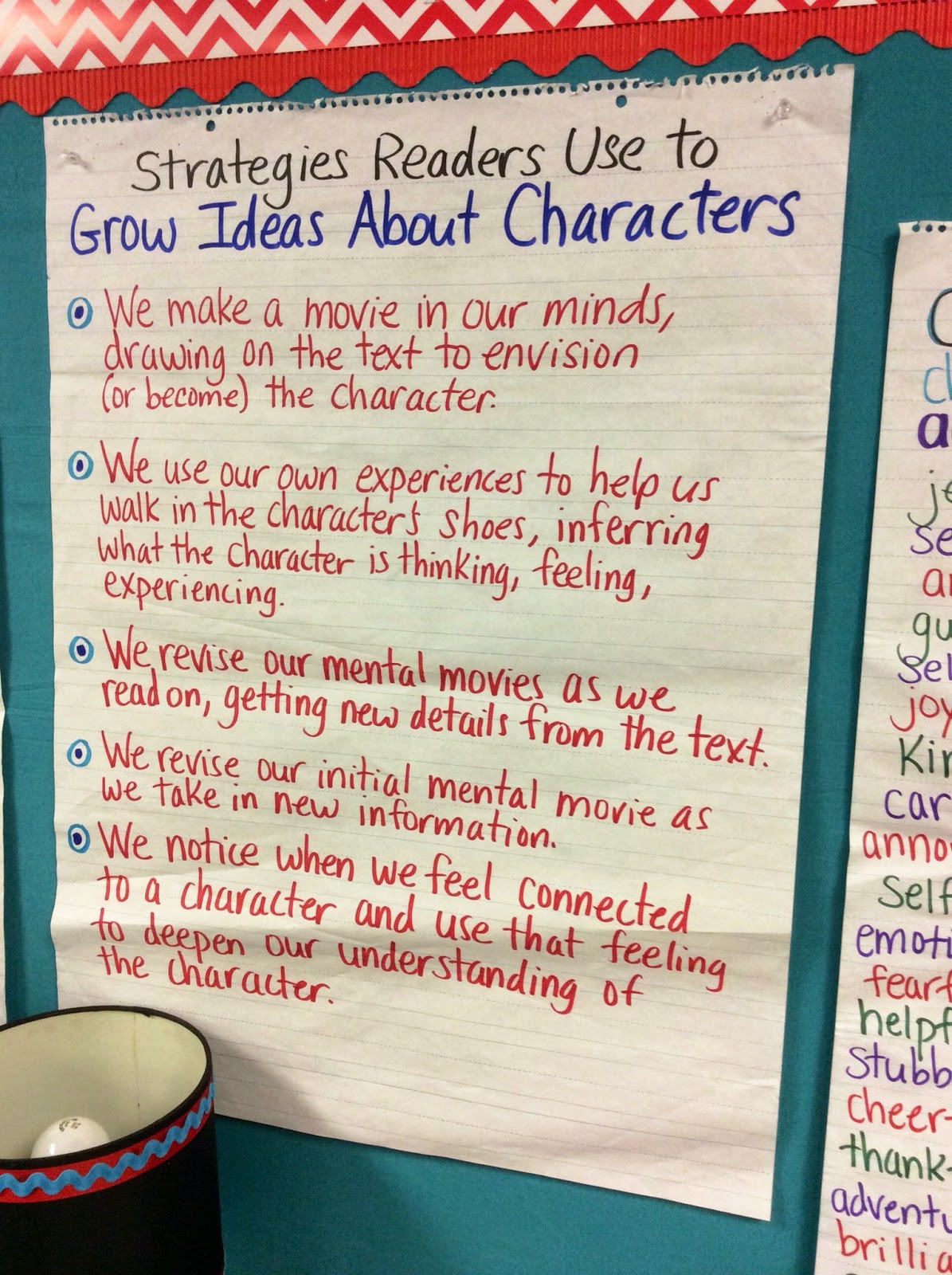
An anchor chart suggested by the Lucy Calkins Reading Workshop
book "Following Characters Into Meaning"
The story line covers some thought-provoking issues such as The Great Depression, poverty, class differences, immigration issues, migrant workers, strikes, and racism.  At this age, students may have not heard some of these vocabulary words, but they are old enough to grasp the meaning and are able to have a discussion of what they think and how it pertains to the story and characters.  We've had some great discussions about how these issues have affected the characters in the story.

The novel also lends itself to naturally teaching about character traits, symbolism, theme, and figurative language- which are some of the reading skills that are introduced to our 5th grade students.

Character Maps
While reading Esperanza Rising, students created character maps in their Reading Notebooks.  Below are some examples.


Character maps for Esperanza, Mama, and Papa.
Character maps for Hortensia, Alfonso, Miguel, and Abuelita.


In addition to students keeping a character map in their Reading Notebook, I create character maps on large chart paper and hang them up around the room for easy reference.  I usually begin with the simple question, "What do we know about this character?"  After each chapter, we can add new characters that are introduced, or add more things that we find out about a character.

Character Traits
As we studied the character's in Esperanza Rising, some of the mini-lessons focused on character traits.  Students made lists of character traits in their Reader's Notebook.  They practiced identifying precise words to describe a character.  Students used sticky notes to jot down information about character's that were featured in their own independent reading texts.  An important piece of this assignment was providing evidence to support the character trait.  I asked students, "Why is the character like that?, How do you know?  What evidence from the text can support your character trait?"  I told students they need to prove it!


An anchor chart that reminded students what to put on their sticky note.
The circle with an M is for my last name.  I have four sections of students,
so I have students put their homeroom teacher's initials in a circle by their name.
Reading Summaries
Students wrote short reading summaries in their Reading Notebook after we read each chapter.  This was mainly so they could keep track of what characters are doing, how they are changing, and the main events of each chapter.  It's almost like a vertical time-line of events.  I started off by modeling how to write it.  We first brainstormed and identified the important events of the chapter, or the section that I read that day.  Then, I modeled how to write it using chart paper.  I did this just a few times, then gradually released them to do it independently.  After we read, we would always discuss the important parts of what was read and discuss ideas for what students could write in their quick summaries. We also took time for students to share their summaries with partners or with the class.  Below are a few examples of student summaries.  


Examples of reading summaries from Esperanza Rising.
Symbolism
Each chapter in Esperanza Rising has the title of a fruit or vegetable.  The tiles of the chapters symbolize something important in Esperanza's (the main character's) life.  Below is a chart that students used to keep track of the symbolism behind each chapter.


Reading Responses
Students wrote reading responses that correlated with open-ended questions about each chapter.  I used a Reading Response Checklist so students would remember to write in proper paragraph form.  Below are examples of the checklist and some student responses that show their thinking about their reading.


We aren't quite finished with the book yet, but I have a few more things planned for students.  After we complete the book, students will complete a comprehension test with multiple choice and essay questions.  I've also thought about having them re-write the ending.  This idea came to me as students were discussing the book and making predictions about what they thought was going to happen, or what they would like to happen.  Writing their own ending might give them a chance to explore some of these unique ideas.

Esperanza Rising is a favorite chapter book of mine, but there are so many other books with great story lines and characters that I could use for this reading unit.  I'm already thinking about what I may read to students next year.  I love classic literature, but there's also so much great NEW literature that's emerging on the scene.  So...I'm thinking.  I'll let you know what I come up with!

Happy Reading!
-Karen

Tuesday, August 26, 2014

A 5th Grade Reading Classroom Tour

This is a tour of my 5th Grade Reading Classroom.  I recently transferred from one elementary school to another and changed teaching positions.  I used to teach a self-contained class and now am teaching reading and vocabulary to four sections of fifth grade students.  This is my 18th year of teaching and I am so excited for a new challenge.  So, it's a new classroom, a new school, and a new teacher position for me.  Lots of changes. Here's the new look of my reading classroom. I hope you enjoy and leave with a few ideas.  Happy teaching!
Welcome to my 5th grade reading classroom.

This is what my classroom looked like before I moved in!  I had two large metal storage cabinets, a teacher desk, two bookshelves, a round table, and student desks and chairs. Wait until you see the transformation!
                               
                                        Q

My reading mini-lesson area.  I also use this area for morning meeting.  I bought the wicker chair from Garden Ridge and the little table from Big Lots.  It is a comfy spot to read and to teach lessons to my students.  The chart stand is perfect for writing anchor charts and the bulletin board behind this area will serve as our anchor chart display.  The book baskets to the right in the picture are for our leveled library.  I got the shelves at Big Lots when they went on sale and I had a 20 percent off coupon.  My husband put them together.  I found the turquoise baskets at Big Lots as well.  I made the level signs with scrapbook paper and my Cricut.  Now, my students can easily find books on their level.


This is a cozy reading nook for students.  I found the red plastic Adirondack chairs at Lowe's, the turquoise pillows and READ letters at Old Time Pottery, the rugs at Ross, the curtains at Garden Ridge,  and the inspirational signs at Big Lots.  The lanterns and pom poms came from a party supply store.  I also have pillows that students can use while reading around the room. My students love all the cozy places to read.   I am always on the lookout for bargains for my classroom.


This is our leveled classroom library for chapter books.  The cube shelving units I got at Big Lots were the perfect size for the turquoise baskets that I got at the same place.  These shelves keep our classroom library books organized and easy to find.


Here's how I display magazines in my classroom.  It's just three hooks and one curtain rod.  Magazines are in plastic sheet protectors and hung on the rods with shower rings with clips.  I keep a variety of magazines for students:  Time for Kids, Zoo Books, Kids Discover, American Girl, A Boy's Life, Ranger Rick, and Scholastic News.  


It takes everyone in the class working together to make a successful classroom, so everyone has a weekly job.  I used library pockets that have each job listed, along with a job description, and Popsicle sticks with numbers.  For completing their jobs, students get paid in tickets at the end of the week.  It's a great way to get things done efficiently and promote responsibility in students.  They love having a job every week, and they especially love getting paid.

Here's my teacher desk area.  I have to say that it is "organized chaos"!  I keep my teacher materials in the black storage cabinet behind my desk and I organize weekly assignments in the caddy that has labels for Monday through Friday.  I have a round table with small stools that I use for small groups (I'll add a photo later when I post about small group management).  

 This is how I organize our daily lunch count.  It also acts as the attendance count.  Students move their round wooden circle with their personal number to their lunch choice for the day.  If a student doesn't make a choice, then I know they are absent.   I made the signs on my Cricut and bought the wooden circles at Michael's craft store, painted them, and glued magnets to the back.  One of the student jobs is to fill out the lunch count for the cafeteria.

I didn't have enough bookshelves, so my handy husband made some simple black wooden shelves for me.  They are the perfect size for these red tubs I found at Wal-Mart.  These tubs are for pictures books and non-fiction books which are also organized by F&P level.

                      So, this is my 5th Grade Reading Classroom. Thanks for stopping by.                                Have a wonderful school year!