Showing posts with label reading responses. Show all posts

Thursday, January 29, 2015

Visual Notetaking

You may be wondering, "What exactly is visual notetaking?"  Well, it's the idea of representing ideas non-linguistically.  Or, you could say it's a fancy way of drawing pictures to represent what you're thinking.  Either way, it's a great tool to use in the classroom and will engage your learners.


From my experience, kids love to draw and doodle.  So, why not let them do it in an academic subject.  I can get just as much insight into what they know by looking at their visual notetaking versus traditional notetaking.

Visual notetaking can include concept maps and webs, plus utilize fancy lettering, connectors, bullets, frames, peeps, and thought /dialogue boxes.  It can be a combination of words AND pictures to represent ideas.

It's just one more tool that students can use to process information and a tool that you can use as a teacher to asses your student's thinking.

Students can use their visual notetaking to spur discussions about what they're thinking.  Plus, they get to show off their cool drawings to classmates!

There are also some white board applications that allow you to show animation videos which include audio narration that are synchonized to screencasts of your drawings.  How cool is that?  As I delve deeper into this creative way of notetaking, I'll share what I find out as I experiment with the smartboard applications.

If you want to know more, or see more examples, just google "visual notetaking" and there's tons of information out there.  There are even some video tutorials.  Give it a try!

I introduced visual notetaking while reading a novel with my students.  I first explained what it was and asked them, "How would you like to be able to draw pictures AND use words to show what you're thinking?"  A unanimous YES filled the room!

We discussed the anchor chart below which showed different types of symbols they could use in thier visual notes.


We then did some visual note taking together as we processed the first few chapters of the novel. Here is the example of our shared visual notetaking.


It looks like a mess, but that is exactly what visual notetaking looks like.  This is a very spatial and global way of thinking and it may drive some of your students crazy. Some of my own students like neat and orderly notes, and that's OK!  That's how they like to process and think.  Give them a choice and let them decide how they'd like to take notes or respond to a text.  Choices are always a plus in my book!

Here are some examples of my 5th grade reading student's visual notes from the novel, The Boy in the Striped Pajamas.  Instead of a traditional reading response, I let them do their response in the form of a visual notes.

I LOVE the expressions on the character's faces.  This student uses peeps
 and dialogue boxes to show what happened in the chapter.

This student uses peeps, dialogue boxes and thought bubbles to
show what the characters are thinking and feeling.


This student chose to use peeps with dialogue boxes and thought bubbles,
plus short summaries of each chapter.


Just by looking at these, I could tell my students "get it"!  They could tell me the big ideas from each chapter in a very creative way.  Plus, they LOVED drawing in reading class!
-Karen

Tuesday, October 14, 2014

Esperanza Rising- A Great Character Study

In the district where I teach 5th grade reading, we use the Lucy Calkins Reading Workshop approach.  The Reading Workshop has several units that focus on different teaching points.  For the "Following Characters Into Meaning", I have chosen to read Esperanza Rising by Pam Munoz Ryan and relate it to my Reading Workshop mini-lessons.  This specific reading unit, "Following Characters Into Meaning", focuses on understanding character's thoughts, motivations, feelings and how they all relate to the story and other characters.  

The novel, Esperanza Rising, is a great fit for this particular unit and my 5th grade students because it has great characters, it has a Fountas & Pinnell reading level of V, and it is written at a 5th grade interest level. In my 5th grade classes, it is accessible to the majority of students for reading independently and for searching for text evidence for written responses.  

To make the novel manageable for mini-lessons, I have broken up the chapters into two or three parts and read one part each day.  This allows time for the mini-lesson, discussion, reading responses, and time for students to do their independent reading.


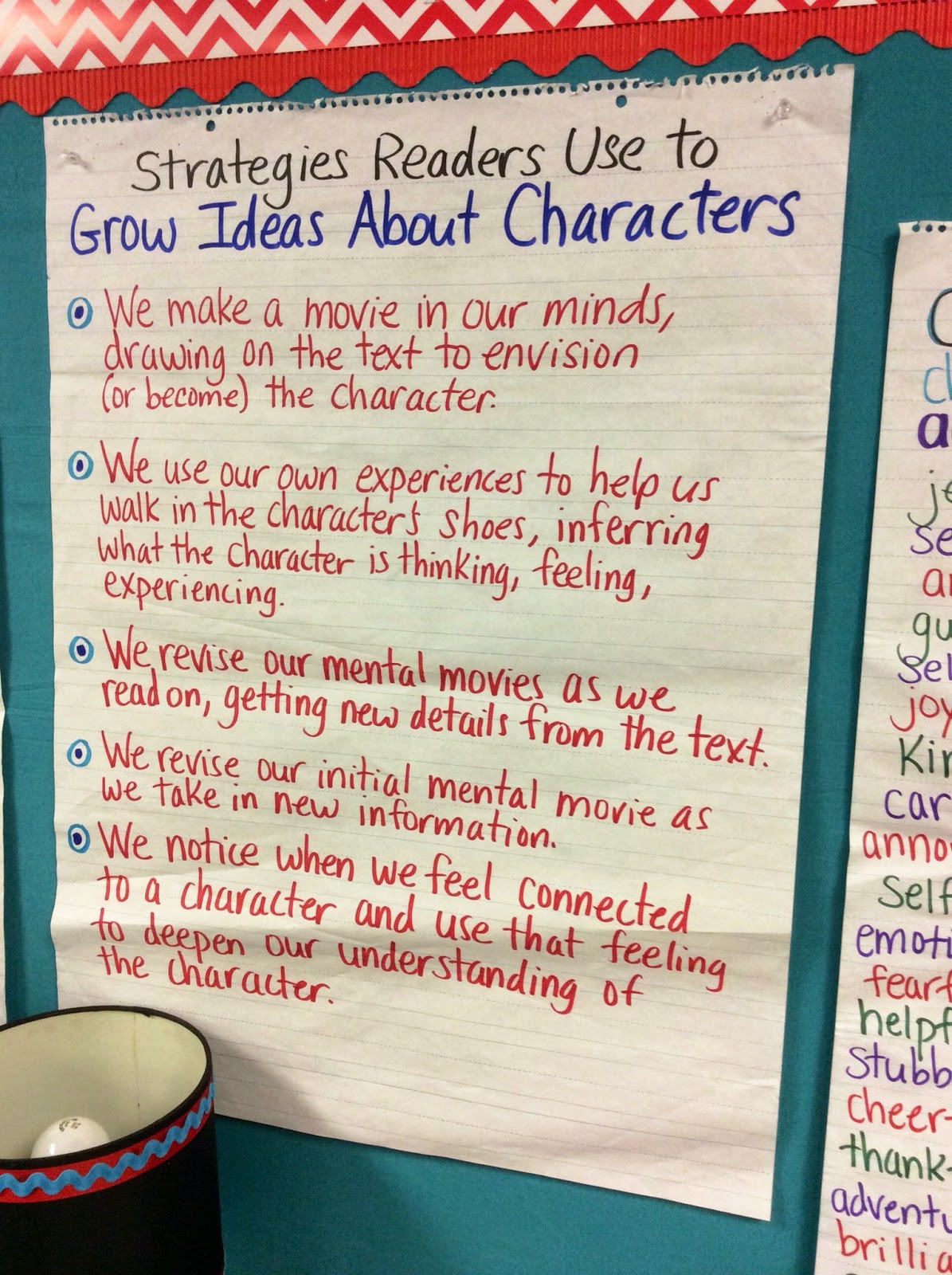
An anchor chart suggested by the Lucy Calkins Reading Workshop
book "Following Characters Into Meaning"
The story line covers some thought-provoking issues such as The Great Depression, poverty, class differences, immigration issues, migrant workers, strikes, and racism.  At this age, students may have not heard some of these vocabulary words, but they are old enough to grasp the meaning and are able to have a discussion of what they think and how it pertains to the story and characters.  We've had some great discussions about how these issues have affected the characters in the story.

The novel also lends itself to naturally teaching about character traits, symbolism, theme, and figurative language- which are some of the reading skills that are introduced to our 5th grade students.

Character Maps
While reading Esperanza Rising, students created character maps in their Reading Notebooks.  Below are some examples.


Character maps for Esperanza, Mama, and Papa.
Character maps for Hortensia, Alfonso, Miguel, and Abuelita.


In addition to students keeping a character map in their Reading Notebook, I create character maps on large chart paper and hang them up around the room for easy reference.  I usually begin with the simple question, "What do we know about this character?"  After each chapter, we can add new characters that are introduced, or add more things that we find out about a character.

Character Traits
As we studied the character's in Esperanza Rising, some of the mini-lessons focused on character traits.  Students made lists of character traits in their Reader's Notebook.  They practiced identifying precise words to describe a character.  Students used sticky notes to jot down information about character's that were featured in their own independent reading texts.  An important piece of this assignment was providing evidence to support the character trait.  I asked students, "Why is the character like that?, How do you know?  What evidence from the text can support your character trait?"  I told students they need to prove it!


An anchor chart that reminded students what to put on their sticky note.
The circle with an M is for my last name.  I have four sections of students,
so I have students put their homeroom teacher's initials in a circle by their name.
Reading Summaries
Students wrote short reading summaries in their Reading Notebook after we read each chapter.  This was mainly so they could keep track of what characters are doing, how they are changing, and the main events of each chapter.  It's almost like a vertical time-line of events.  I started off by modeling how to write it.  We first brainstormed and identified the important events of the chapter, or the section that I read that day.  Then, I modeled how to write it using chart paper.  I did this just a few times, then gradually released them to do it independently.  After we read, we would always discuss the important parts of what was read and discuss ideas for what students could write in their quick summaries. We also took time for students to share their summaries with partners or with the class.  Below are a few examples of student summaries.  


Examples of reading summaries from Esperanza Rising.
Symbolism
Each chapter in Esperanza Rising has the title of a fruit or vegetable.  The tiles of the chapters symbolize something important in Esperanza's (the main character's) life.  Below is a chart that students used to keep track of the symbolism behind each chapter.


Reading Responses
Students wrote reading responses that correlated with open-ended questions about each chapter.  I used a Reading Response Checklist so students would remember to write in proper paragraph form.  Below are examples of the checklist and some student responses that show their thinking about their reading.


We aren't quite finished with the book yet, but I have a few more things planned for students.  After we complete the book, students will complete a comprehension test with multiple choice and essay questions.  I've also thought about having them re-write the ending.  This idea came to me as students were discussing the book and making predictions about what they thought was going to happen, or what they would like to happen.  Writing their own ending might give them a chance to explore some of these unique ideas.

Esperanza Rising is a favorite chapter book of mine, but there are so many other books with great story lines and characters that I could use for this reading unit.  I'm already thinking about what I may read to students next year.  I love classic literature, but there's also so much great NEW literature that's emerging on the scene.  So...I'm thinking.  I'll let you know what I come up with!

Happy Reading!
-Karen